

Oskar Petros stared out to where the bright white horizon butted up against the pitch black beneath the full Earthrise. If he squinted, he could almost make out the panel-layers tracking back and forth, turning lunar silica into solar panels. It had been a good business, he thought bitterly.
“Dr. Petros. You cannot put us off like this.” Jane Sedgewick, Union Boss, said from behind him. “You wouldn’t want a strike to disrupt—”
After all, why buy energy all the way from the Moon, when the U.S. military had fully scaled up Bussard Polywell Fusion, and was in the process of licensing it out? The reactors were pretty easy to build—it wouldn’t take long—not long at all—before they were everywhere.
“It wouldn’t,” she said. “But these frustrations will find an outlet if left unanswered.”
“I know, I know,” Oskar said, waving his hand at her. “You know this isn’t any easier for me, either.”
After all, why buy energy all the way from the Moon? The reactors were pretty easy to build—it wouldn’t take long—not long at all—before they were everywhere.
Her expression softened slightly. “Look, personally, I can sympathize. But this is business, not personal. You have 450 Union employees here you’re responsible for.”
“The reason I haven’t said anything yet is because I am still trying to figure out what to do.” He’d recruited most of his workers from Earth; he’d paid for their pricey transport to the Moon, and none of them would be able to afford to get back to Earth on their own.
“Well, you could at least say that,” she said. “Any statement would help me tamp things down.”
Oskar’s company, Lunar Energy, harvested solar energy at the lunar surface, captured and packaged it in both chemical and thermal form, and sent it Earthside. There were maybe three or four companies on the moon doing the same thing—LE was the largest. All of them about to be put out of business by the announcement out of China Lake.
After all, why buy energy all the way from the Moon, when the U.S. military had fully scaled up Bussard Polywell Fusion, and was in the process of licensing it out? The reactors were pretty easy to build—it wouldn’t take long—not long at all—before they were everywhere.
LE did still have the materials processing side of the business—materials that could best be made at low temperatures in a near-perfect vacuum—other natural resources rare on Earth but plentiful on the moon. But that sideline brought in only ten percent of revenue, and only made sense riding on the infrastructure from the energy business.
“Fine,” he said. “I’ll talk to the workers tomorrow. We’ll set something up during lunch.”
“Thank you very much, Dr. Petros. I’m sure it will go fine—we’re not unsympathetic.” She showed herself out of his office.
She’ll run for office someday, Oskar thought. She’d come up as a logistics administrator, and risen to run the union shop at LE. And what the union did at LE drove what the union did at the other companies.
He sank into his desk chair, feeling heavy even in the light lunar gravity. He touched the screen. “Call Rex,” he said. He was going to need to talk to the bank.
Rex appeared on the screen, straightening the real silk tie under his real wool suit. “Oskar. Nice to see you. How’s the family?”
“How’s the family?” Oskar said. “Do you really want to know? I’ll tell you. Lindie still hasn’t realized what’s happening—she’s still young enough to be excited by the fusion. Kayla, on the other hand… Well, she’s probably more anxious than I am.”
“Well, I can understand that,” Rex said. “I’m affected by this too, you know.”
Really? Oskar thought. He didn’t think anything could hurt the banks. “I think you know why I’m calling,” he said.
Rex nodded. “Yes. Not hard to anticipate, so I’ve already been looking some things over. Not just for you, but for the others—really almost everybody on the Moon. You’re better off than most—you had a lot less debt than some others.”
“I thought I had no debt.”
“Well, not really,” Rex said, “just your revolving business credit—that you use to buy supplies and shipping and stuff.”
“So I can use the whole liquidation.”
“Yeah,” Rex said, bobbing his head.
Oskar opened his balance sheet on another monitor. All the assets spelled out—the office, the plant, all the equipment, all the current supply stock; plus banked energy and finished panels and special materials. Balanced against the cost of shipping the products back to Earth.
“But,” Rex said. “You have to consider that, even as we sit here talking, the value of your physical plant is plummeting. The Moon, ironically, is becoming radioactive, figuratively speaking.” He looked away from the camera. “I’ve got your inventory and balance sheet here—I’ll update it with the current prices, and email it over to you. Should I assume you’re going to want to proceed with the liquidation?”
Oskar nodded non-committaly. “Probably,” he said. Not that he saw any alternative.
“I’d suggest you not sit around,” Rex said. “The one cost that’s going up is Earth-bound passage. The longer you wait, the more it’ll cost to move back Earthside.”
“Yeah, I’ll keep that in mind,” Oskar said, and he shut the connection.
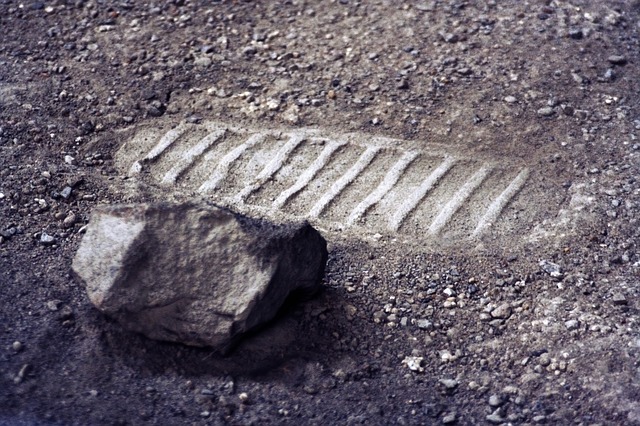
Nothing but a waist-high wire fence kept anyone with a functional moonsuit from violating the landing site. Beyond the fence, the Eagle’s base with the Nixon plaque, the old wire-stiffened U.S. flag, the footprints. Either the Lunar Territorial Government counted on the idea that no one with a moonsuit would trespass, or they simply didn’t care. At least, not enough to spend any money on it, even though it was only 100 meters from Tranquility City’s outer wall. Hardly anybody living on the Moon came out here. And with the cost of lunar travel so high, no one came from Earth.
I could break my helmet seal, Oskar thought, and pass into history—become a permanent part of the site. He could freeze himself there—an ersatz astronaut statue.
Well, probably, they’d cart his body away. But they’d probably at least lay a plaque. Maybe a vacuum-frozen flower bouquet to mark the spot, not too far from the one from 98 years before. He could macabrely toy with the image, but contemplating actual suicide? Unthinkable.
All would soon be lost. Thirty years before, he’d sold his stake in their family’s carbon business to his older cousin Simon, and used the cash to start Lunar Energy. He couldn’t stomach the thought of going back to the carbon business—back to Pennsylvania to turn coal dust into graphene, nanotubes, and vapor-deposition diamonds. He’d have to get used to it, he thought.
He turned to go back home. Home, at least, for a little while longer. He still had to figure out how he was going to come up with the cash to get his employees back to Earth. He owed them that much, at least.
But when he got back to the airlock, he found it on lock-down—it wouldn’t open.
“Tranquility egress control, this is Petros. Requesting re-entry.”
“Petros, Tranquility. Negative. We’ve got a walker in the airlock.”
Walker! Oskar thought. Someone attempting suicide by going out the airlock without a suit. Not easy to do, given the airlock surveillance and the fact that the computer wouldn’t let the lock open if it saw someone without a suit.
He pressed his helmet against the airlock window. Hunched in the corner, a figure in most of a suit. The helmet was off, on the floor next to the figure’s feet—bare feet.
Clever, that, Oskar thought. Figuring that the cameras wouldn’t look down that low. Go into the airlock with a complete suit, helmet and all. But without boots.
“I see him, Tranquility,” Oskar said. “Who is it?”
“Rih Shun Lih. Do you know him?”
Rex, Oskar thought. That was Rex’s “real” name.
“Yes, I know him well,” Oskar said. He peered through the window again. Rex slumped away, facing the corner. The inner lock door sealed—probably digitally jammed by Rex, the outer lock door jammed by Tranquility Control. Impasse. “We both came up to the Moon on the same ship—he’s been a friend since.” Not entirely true—Rex emigrated to the Moon 15 years after Oskar. But if he could help save a life with a white lie? “Any chance you’d patch me through?”
“The cops are on their way, Petros,” Control said. “They’ll get him out.”
“Could it hurt?” Oskar said. “You’ve got the outer door sealed, right?”
Pause. Some whispering off the line. “OK, we’ll pipe you through. But the cops will be monitoring, so they’ll cut you off if they think you’re headed in the wrong direction.”
“Understood, Control. Rex—it’s me—it’s Oskar. You OK?”
“Do I look OK, Oskar?” Rex said. “And where are you?”
“I’m outside. Waiting to get in.”
Rex stood up, and peered out the airlock door. “Well, then. Open the door and come on in!”
“Can’t. Lock’s occupied.”
“The person there wouldn’t mind if you opened it up,” Rex said.
“Then I would be guilty of murder,” Oskar said.
A pause. “Didn’t think of that,” Rex said. Then he fell silent.
“What are you doing in there, anyway?” Oskar said. “Why this, now?”
“I can’t go back to Guangzhou,” he said. “I… I can’t. I love living on the Moon. But I can’t go back to China. And especially not as a failure. And I thought, this way, I could be part of something important on the Moon forever.”
“How are you a failure, Rex?” Oskar said. “I hadn’t even heard that the branch was closed.”
“Not yet,” Rex said. “But that’s just a formality. With cheap fusion on Earth, no industry for the Moon, there won’t be any need for any banks up here anymore.”
“Suppose you’re right about that,” Oskar said. “How is that your fault? How is it your fault—how did you fail—because people you had no control over made something new?”
“Maybe it works that way in the West,” Rex said. “But in my family… My father laughed at me when I went into banking. And he laughed harder when I said I was going to the Moon. And then to go back, like this?”
Oskar nodded. He’d felt some of the same things. How could he go back, hat in hand, to Simon? But he’d find a way. He’d find something. He could not imagine actually killing himself. But he could imagine, in practical terms, anyway, better ways of doing it than trying to walk out the airlock without boots. You’d never get very far—your feet would freeze off… He said to Rex, “You know, if you want to talk about failure… This idea of yours, trying to walk barefoot in the lunar sand? Wouldn’t work. You’d step outside and your feet would freeze off—you’d end up face-down in the dirt. And, likely as not, your suit would seal up at the ankles. So you’d still be alive. Just without feet.”
Silence from Rex. Then: “I thought if I didn’t purge the air first, the pressure would push me most of the way to the Eagle.”
Oskar—trained as a materials scientist—ran some numbers in his head. “Probably about a third of the way,” he said. “So you’d be face-down, maybe 50 meters from the door. Talk about lack of dignity!”
“I hadn’t thought about it that way,” Rex said.
“Well, if you hadn’t thought it all the way through, then maybe you don’t really want to be dead.”
“No, I guess I don’t,” Rex said. “I just don’t see any way out.”
“We’ll find something,” Oskar said. “Now just release the inner lock, and let the cops come get you.”
“Yeah. I guess,” Rex said. “You know, it’s a shame, though, too. After us, almost no one will see Tranquility or the Eagle again.”
Yes, Oskar thought. A real shame. A real piece of human history that almost no one would see, once the colony was packed up and shipped back Earthside. Even as fusion made energy cheap—even now that BoeingBus would start making micro-fusion propulsion engines—no one would be coming to the Moon to see this.
Unless… He started running some other calculations in his head. Could it work, commercially? Moon tourism had never taken off before, but with the energy equation changing…
“Hey, Rex?” Oskar said. “By the way, once we get settled inside? I’d like to see if we can run some numbers on something new.”
Two years later, June, 2069. Oskar stood to one side, watching Jane Sedgewick—now Mayor—give a short speech while wielding an enormous pair of scissors. Workers had strung a ribbon across the corridor leading the 150 meters from the old city wall to the new Tranquility Base Dome Oskar had built.
“We have Dr. Petros to thank for this new lease on Moon life,” Sedgewick said. “He sold nearly everything he had—gave up what had been a successful energy harvesting business—to finance and build this dome—and others like it at other landing and historic sites. To say nothing of getting other Lunar Leaders to invest in expanding the space port! Tranquility Base Dome opens to the off-world public next week—and already, the hotels are booked solid for the next year!”
The next year—the centennial year, July to July, 2069-2070, of course. Oskar looked out into the crowd, and caught Kayla’s eye. She smiled back at him. He turned to Rex, standing next to him on the dais. “Couldn’t have done it without you,” he whispered.
“Let’s just see if the tourists keep coming, after the centennial,” Rex whispered back.
“They will,” Oskar said, “they will.”